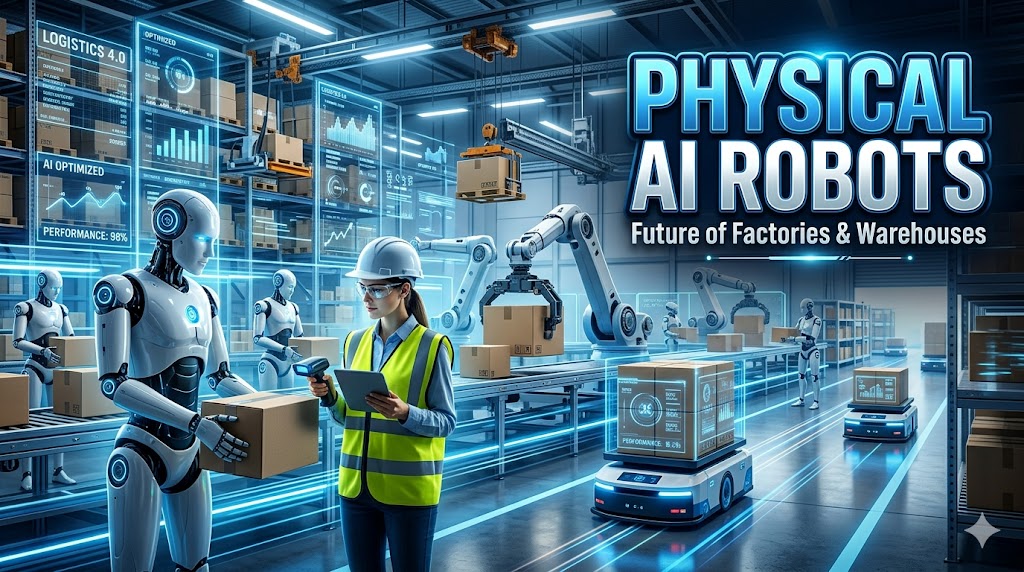
The rise of Physical AI robots is transforming how factories and warehouses operate across the world. Companies are now deploying collaborative robots equipped with advanced spatial reasoning and adaptive learning systems. These robots can identify objects, move safely alongside workers, and handle unpredictable tasks in real time. As automation investments grow in India and global markets, experts believe Physical AI could redefine industrial productivity. At the same time, manufacturers are focusing on faster deliveries, lower operational costs, and improved workplace safety through intelligent robotic systems designed for human collaboration.
What Are Physical AI Robots?
Physical AI robots combine artificial intelligence with real-world robotic movement. Unlike older industrial machines, these robots learn from their environment and adapt quickly.
They can recognize obstacles, understand spatial layouts, and improve performance over time. As a result, businesses are using them for packing, sorting, lifting, and assembly tasks. The technology also supports safer human-machine collaboration in busy industrial environments.
Warehouses Are Accelerating AI Automation
“Global warehouse operators are rapidly testing collaborative robots to improve efficiency. Many logistics companies now rely on AI-powered systems during peak delivery periods.
These robots can move products independently and react instantly to sudden changes. Therefore, businesses reduce delays and lower dependence on repetitive manual labor. Analysts believe demand for smart warehouse automation will continue rising over the next decade.”
Manufacturing Units Are Adopting Smarter Robots
“Manufacturing companies are upgrading factory floors with intelligent robotic arms and mobile systems. These machines can detect product variations without constant programming updates.
As a result, factories achieve better production consistency and fewer operational errors. Sectors such as automotive, electronics, and consumer goods are leading adoption. Experts say Physical AI will become a major industrial investment trend across Asia and Europe.”
Human Workers Still Play a Key Role
“Despite rapid automation, companies are not replacing entire workforces overnight. Instead, Physical AI robots are designed to support human workers in repetitive or risky tasks.
Workers continue handling supervision, quality checks, and decision-making operations. In addition, collaborative robots reduce workplace injuries caused by heavy lifting or hazardous conditions. This balanced approach is encouraging wider acceptance among industrial employees.”
AI Learning Is Making Robots More Flexible
“Traditional robots struggled in unpredictable environments. However, newer AI models allow machines to continuously learn from real-world experiences.
For example, robots can now identify damaged boxes, adjust gripping pressure, and navigate crowded spaces safely. These improvements increase operational reliability. Industry experts believe adaptive learning will become the biggest competitive advantage in industrial robotics.”
India Could See Faster Industrial Adoption
“India’s manufacturing and logistics sectors are expected to gradually adopt Physical AI. Government initiatives supporting smart manufacturing may also encourage investment in intelligent automation systems.
In addition, e-commerce growth is creating demand for faster warehouse operations across the country. Technology companies are already exploring AI-powered robotic solutions for industrial hubs. This shift could improve productivity while supporting long-term infrastructure development.”
Challenges Still Need Attention
“Although Physical AI is advancing quickly, businesses still face cost and training challenges. High deployment expenses remain difficult for smaller manufacturers.
At the same time, companies must train workers to operate alongside intelligent robotic systems. Cybersecurity and machine reliability also require continuous monitoring. Nevertheless, experts expect technology costs to decrease as adoption expands globally.”
How to
How to prepare factories for Physical AI robots?
Start with automation audits, worker training, and small robotic pilot programs.
How to improve warehouse efficiency using Physical AI?
Use adaptive robots for sorting, inventory movement, and real-time logistics management.
How to train workers for Physical AI systems?
Provide safety training and hands-on experience with collaborative robotic tools.
Pro Tips
- Businesses should begin with small-scale Physical AI pilot projects.
- Worker training improves safety and increases robot efficiency.
- Adaptive AI systems perform better in changing warehouse conditions.
Conclusion
Physical AI robots are becoming a major force in global automation. Warehouses and factories are now preferring smarter systems that adapt to unpredictable environments while supporting human workers. This transition is helping companies improve speed, safety, and operational consistency without fully removing human involvement from industrial processes.
India could become an important market for collaborative robotics in the coming years. As AI technology becomes more affordable, more industries may adopt intelligent automation solutions. Businesses and workers who stay updated with these trends will likely benefit from the next phase of industrial transformation.
FAQs
What are Physical AI robots?
Physical AI robots are intelligent machines that combine AI software with real-world robotic movement and learning abilities.
Why are warehouses using Physical AI robots?
Warehouses use Physical AI robots to improve efficiency, reduce delays, and support safer operations.
Can Physical AI robots replace workers completely?
No, Physical AI robots mainly assist workers with repetitive and physically demanding