

AI Image Generator vs Human Designer: The Future of Creative Design Battle
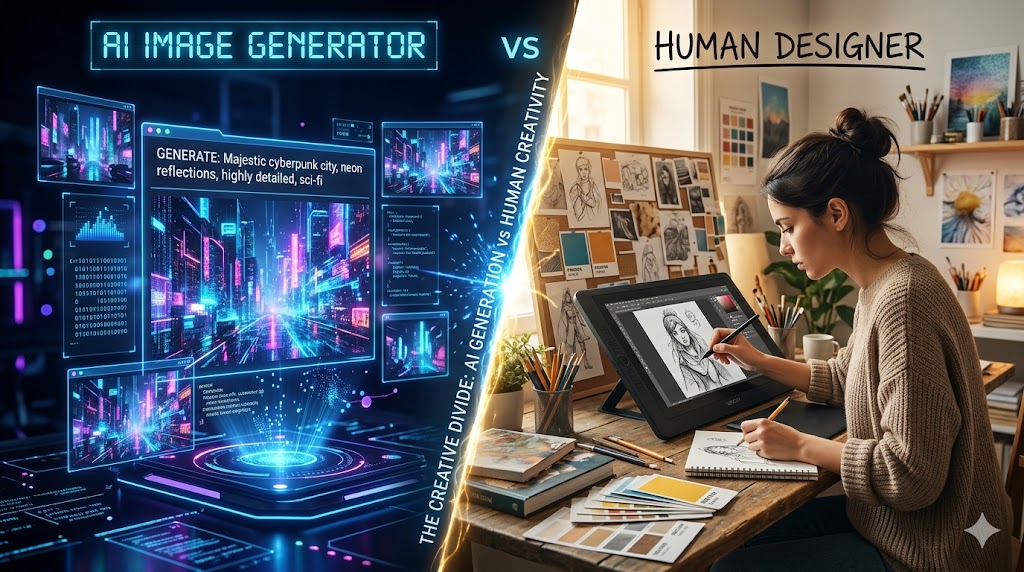
In the last few years, the creative industry has experienced a massive transformation. What once required years of training, expensive software, and deep artistic skill can now be done in seconds using AI image generators. Tools like Midjourney, DALL·E, and Stable Diffusion have made it possible for anyone to create visually stunning artwork just by typing a text prompt.
But this raises a powerful question that designers, marketers, and creators are constantly debating: Can AI really replace human designers, or is human creativity still irreplaceable?
The truth is not as simple as choosing one over the other. Instead, it is a growing balance between machine efficiency and human imagination. To understand this properly, we need to look at how both sides work, what they excel at, and where they struggle.
The Rise of AI Image Generators
AI image generators are built on advanced machine learning models trained on millions of images. These systems learn patterns, styles, colors, lighting, textures, and artistic techniques from vast datasets. When a user enters a prompt like “cinematic sunset portrait of a futuristic city,” the AI interprets the text and generates an image that matches the description.
What makes this technology powerful is its speed and accessibility. In the past, creating a high-quality illustration could take hours or even days. Now, it takes seconds. Even someone with zero design experience can produce professional-looking visuals.
AI tools are especially popular in:
- Social media content creation
- Advertising mockups
- Concept art for games and films
- Blog and website visuals
- Marketing campaigns
However, while AI is fast and efficient, it does not truly “understand” creativity the way humans do. It predicts patterns based on data rather than expressing emotion or intention.
The Strength of Human Designers
Human designers bring something that AI currently cannot replicate: intentional creativity.
A human designer does not just create an image—they communicate a message. Every color choice, spacing decision, typography style, and composition element is carefully selected based on emotion, branding, and audience psychology.
For example, a professional designer working on a luxury brand advertisement will not just make something visually attractive. They will ensure that the design reflects elegance, exclusivity, and trust. This requires cultural understanding, emotional intelligence, and storytelling ability.
Human designers also excel in:
- Brand identity creation
- Emotional storytelling through visuals
- Custom creative direction
- Cultural and contextual sensitivity
- Unique artistic innovation
Unlike AI, humans can break rules intentionally. They can create something completely unexpected or abstract that still feels meaningful. That level of creative intuition is still difficult for machines to replicate.
Speed vs Depth: The Core Difference
One of the biggest differences between AI image generators and human designers is speed.
AI can produce dozens of design variations in seconds. This is extremely useful for brainstorming, idea generation, and rapid prototyping. Businesses love this because it reduces time and cost dramatically.
Human designers, on the other hand, take more time—but that time is used for refinement. They think deeply about concept, audience, message, and emotional impact.
So the real comparison becomes:
AI = Fast idea generation
Human = Deep creative refinement
Instead of replacing each other, they often complement one another in modern workflows.
Creativity: Is AI Really Creative?
This is where the debate becomes interesting.
AI appears creative because it generates unique images, but its creativity is actually based on pattern recognition. It mixes and remixes existing styles from its training data.
A human designer creates from experience, imagination, emotion, and personal expression. Their work often reflects individuality, something AI cannot truly “feel.”
For example, if a designer has lived through a cultural experience or emotional moment, they can translate that into artwork with meaning. AI cannot experience life—it can only simulate outputs.
However, AI is improving rapidly. It is becoming better at style blending, realism, and composition. But originality with intent still leans heavily toward humans.
Cost and Accessibility
Another major advantage of AI image generators is cost efficiency.
Hiring a professional designer can be expensive, especially for startups or small businesses. AI tools offer an affordable alternative that allows quick experimentation without financial pressure.
This has democratized design. Now:
- Students can create portfolios
- Small businesses can design marketing visuals
- Content creators can produce daily graphics
- Freelancers can speed up workflow
But this accessibility also creates saturation. Because anyone can generate images, the internet is now flooded with similar-looking AI visuals. This makes human-designed work more valuable in terms of originality and brand identity.
The Industry Impact
The rise of AI has not destroyed design jobs, but it has changed them.
Modern designers are no longer just “creators.” They are becoming:
- Creative directors
- Prompt engineers
- Brand strategists
- AI-assisted artists
Instead of manually creating everything from scratch, many designers now use AI as a starting point and refine outputs into polished final products.
Companies are also shifting their expectations. Speed is important, but originality and branding consistency still require human input.
Limitations of AI Image Generators
Despite their power, AI tools still have clear limitations:
They sometimes produce incorrect anatomy, unrealistic details, or inconsistent branding elements. AI also struggles with precise client requirements, especially when subtle changes are needed.
Most importantly, AI lacks accountability in design thinking. It does not understand business goals, market positioning, or emotional storytelling in a strategic way.
This is why AI cannot fully replace professional designers in high-level branding work.
The Future: Collaboration, Not Competition
The future of design is not AI vs humans—it is AI with humans.
The most successful creatives will be those who learn how to use AI as a tool rather than seeing it as a threat. AI can handle repetitive tasks, generate ideas, and speed up workflows, while humans focus on direction, storytelling, and refinement.
We are moving toward a hybrid creative model where:
- AI handles execution speed
- Humans handle creativity and strategy
This combination will likely define the next era of digital design.
Final Thoughts
The debate between AI image generators and human designers is not about replacement—it is about evolution.
AI has changed the way we create visuals forever, making design more accessible and faster than ever before. But human designers still hold the key to meaning, emotion, and originality.
Instead of asking “Who will win?”, the better question is:
How can humans and AI create better together?
The answer to that question will shape the future of creative industries.
Leave a Reply