The AI image model trends 2026 landscape is evolving faster than expected. Prompt engineers are now selecting models the same way filmmakers choose cameras.
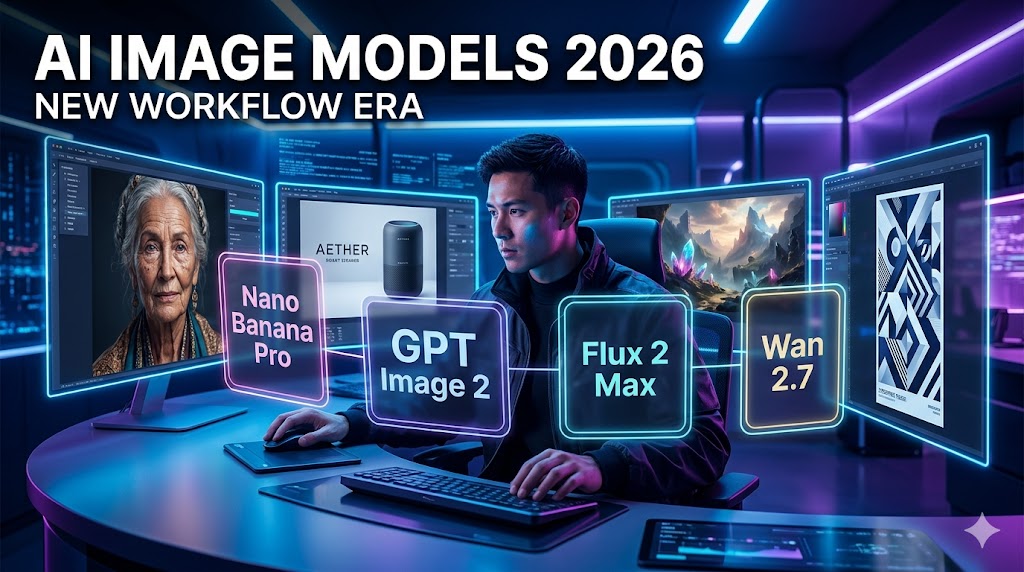
Meanwhile, specialized AI tools are dominating different creative categories. Nano Banana Pro leads portrait realism, GPT Image 2 handles complex branding scenes, Flux 2 Max powers print-ready visuals, and Wan 2.7 is becoming popular for cinematic fantasy frames.
As a result, creators, agencies, and Indian startups are redesigning workflows around model strengths instead of relying on a single universal generator. This shift is now shaping the future of AI content production.
Tools: ChatGPT, Midjourney, Gemini, Leonardo AI, DALL·E, Ideogram AI, Krea AI
QUICK SUMMARY
Nano Banana Pro is leading photorealistic portraits and food photography workflows.
GPT Image 2 dominates detailed scene composition and accurate text rendering.
Flux 2 Max and Wan 2.7 are driving print-quality visuals and cinematic fantasy scenes.
AI Image Model Trends 2026 Are Reshaping Prompt Engineering
Prompt engineering is no longer about writing longer prompts.
Instead, creators are now optimizing prompts for specific AI engines.
This shift became more visible after major 2026 model upgrades. Designers realized that each platform performs better in certain categories. As a result, professionals started building “model-first” workflows.
For example, fashion creators often rely on Nano Banana Pro for skin realism. On the other hand, packaging brands prefer GPT Image 2 because text accuracy is more important in product visuals.
Nano Banana Pro Is Becoming the Portrait Specialist
Google Gemini 3’s Nano Banana Pro is gaining strong attention among photographers and influencers.
The model performs especially well with editorial portraits, warm lighting, and natural skin textures. In addition, food bloggers are using it for realistic organic textures and cinematic café aesthetics.
Anime creators also prefer this model because cel-shaded outputs remain consistent across frames. Consequently, social media creators are adopting Nano Banana Pro for faster publishing workflows.
GPT Image 2 Leads Product Mockups and Brand Design
OpenAI GPT Image 2 is now widely used for commercial product visualization.
Its biggest advantage is accurate text rendering. Labels on perfume bottles, coffee bags, and cosmetics remain readable without distortion. Moreover, the model handles layered compositions more effectively than earlier systems.
Design agencies are also experimenting with exact film-style recreations. Kodak-inspired grain, Polaroid tones, and vintage lighting can now be reproduced with greater precision.
Flux 2 Max Is Dominating Print-Ready AI Graphics
Black Forest Labs Flux 2 Max is setting new standards for ultra-sharp AI output.
Unlike softer cinematic generators, Flux focuses on edge clarity and high-resolution detail. Therefore, it is becoming popular for posters, packaging, billboard designs, and vector-style logos.
Many Indian startups are now using Flux-generated visuals in e-commerce branding. The clean lines also help businesses create minimalist graphics suitable for websites and mobile apps.
Wan 2.7 Is Fueling Cinematic Fantasy Content
Wan 2.7 is attracting creators who want movement-focused compositions. Its fantasy landscapes appear more dynamic and cinematic.
Because of this, video creators often use Wan-generated frames before converting them into animated clips. Meanwhile, gaming artists are experimenting with dramatic lighting and atmospheric world-building.
The model also handles large environmental compositions smoothly. As a result, fantasy storytelling and sci-fi concept art are becoming major use cases in 2026.
Why Prompt Engineers Are Switching to Hybrid Workflows
The biggest 2026 trend is hybrid prompting. Creators no longer rely on a single AI model.
Instead, they combine tools based on output strengths. A portrait may begin in Nano Banana Pro, move to GPT Image 2 for branding, and finish in Flux 2 Max for print enhancement.
This workflow improves efficiency while reducing editing time. Consequently, AI content pipelines are becoming more specialized across agencies, YouTubers, and digital publishers.
AI Image Competition Is Accelerating Across the Industry
The AI image race is no longer limited to chatbots. Visual generation has become a major competitive space.
Companies are investing heavily in photorealism, typography accuracy, and cinematic rendering. At the same time, creators expect faster outputs optimized for mobile-first platforms like Instagram and YouTube Shorts.
Therefore, model specialization may become the defining AI trend of late 2026. Experts believe future prompt engineering will focus more on orchestration than experimentation.
How to choose the best AI image model in 2026?
Match the model with your project type—portraits, branding, or cinematic landscapes.
How to improve prompts for AI image model trends 2026?
Write shorter prompts focused on lighting, composition, and output style goals.
How to create print-ready AI graphics?
Use Flux 2 Max for ultra-sharp resolution and clean edge detailing.
PRO TIPS
Use Nano Banana Pro for realistic portraits and food photography prompts.
Choose GPT Image 2 when packaging text accuracy is important.
Export Flux 2 Max outputs for print-quality branding projects.
CONCLUSION
AI image generation is entering a highly specialized phase. Prompt engineers now choose tools based on creative strengths rather than popularity alone.
This transition is reshaping digital production across photography, branding, anime art, and cinematic storytelling. As competition increases, creators who understand model-specific prompting will produce faster and higher-quality visuals.
Meanwhile, brands are expected to adopt hybrid AI workflows throughout 2026. Staying updated with evolving AI image model trends 2026 is becoming essential for designers, marketers, and content publishers.