

Fastest AI Image Generator Tools Compared (Guide to Speed, Quality & Real-World Performance)
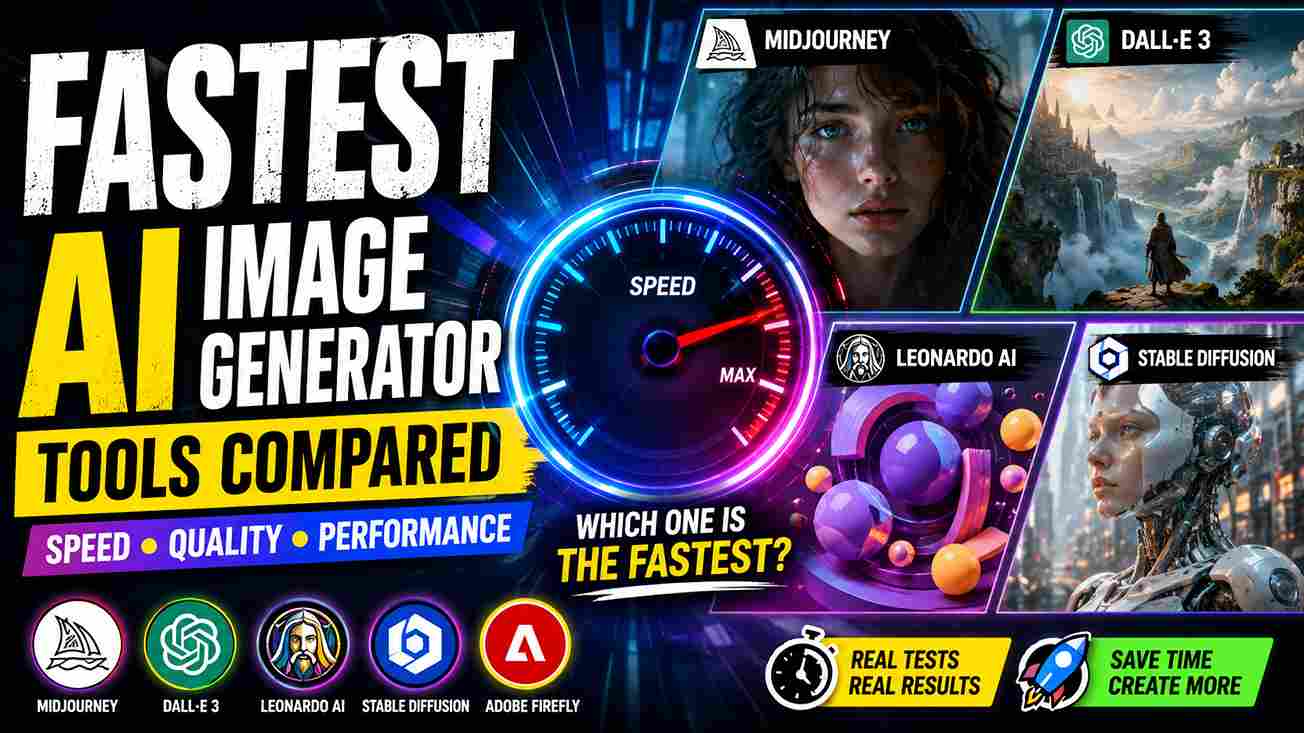
AI image generation has evolved into one of the fastest-growing areas of creative technology. What once took designers hours or even days can now be generated in seconds using advanced text-to-image models. But in 2026, the conversation is no longer just about quality—it’s about speed, consistency, and real production-ready output.
Whether you are a content creator, digital marketer, thumbnail designer, or freelancer, the speed of an AI image generator directly impacts your workflow. A tool that produces stunning visuals but takes too long can slow down your entire creative process. On the other hand, a fast but low-quality generator is useless for professional work.
So, which AI image generator is truly the fastest—and is it worth using?
Let’s break it down in a practical, real-world way.
Why Speed Matters in AI Image Generation
Speed is not just about convenience. In modern content creation, it directly affects productivity and income.
If you are creating YouTube thumbnails, Instagram ads, blog visuals, or client designs, every extra second adds up. Fast generation means faster iteration, more creative testing, and better final results.
For example, a creator testing 20 different thumbnail ideas can save hours if each image is generated in under 10 seconds instead of 1–2 minutes. That difference becomes even more significant in professional workflows.
But speed alone is not enough. The ideal AI tool must balance three things:
- Fast generation time
- High visual quality
- Stable prompt understanding
Now let’s compare the top AI image generators based on real-world performance.
1. Midjourney – Fast, Artistic, and Highly Consistent
Midjourney has built a strong reputation for producing cinematic, high-detail images that often look better than real photography. In terms of speed, it is also surprisingly efficient considering the quality it delivers.
Most images generate in under a minute, and sometimes faster during low server load. The real strength of Midjourney is not just raw speed but perceived speed, because users usually get usable results in the first generation itself.
However, Midjourney is slightly slower when dealing with highly complex prompts or when upscaling images to maximum resolution. Still, for creators who want premium visuals quickly, it remains one of the most balanced tools.
Where it shines is aesthetic control. Lighting, mood, composition, and cinematic depth are often near perfect without needing multiple retries.
In short, Midjourney is fast enough for professionals and excellent for creative storytelling.
2. DALL·E (OpenAI) – Fastest for Simplicity and Clean Outputs
DALL·E is one of the fastest AI image generators when it comes to raw output time. In many cases, images appear in just a few seconds.
Its strength lies in simplicity. You type a prompt, and it produces a clean, structured image almost instantly. Unlike some tools that require tuning or multiple variations, DALL·E focuses on delivering usable results quickly.
However, speed comes with trade-offs. While DALL·E is extremely fast, it sometimes lacks the cinematic depth and artistic richness that Midjourney provides. The images are more practical than dramatic.
Still, for business use, blog illustrations, presentations, and concept visuals, DALL·E is one of the most efficient tools available today.
If your goal is speed + clarity rather than artistic experimentation, this tool is a strong choice.
3. Leonardo AI – Balanced Speed with Creative Control
Leonardo AI has become popular among designers because it sits between speed and customization. It is not the absolute fastest, but it provides a smooth and consistent workflow.
Image generation typically takes only a few seconds to under a minute depending on resolution and model selection. What makes Leonardo AI powerful is its ability to fine-tune outputs without slowing down the process significantly.
Unlike more rigid systems, Leonardo AI allows style adjustments, model switching, and prompt refinement while maintaining decent speed.
This makes it ideal for freelancers and designers working on client projects where iteration is important.
While it may not beat DALL·E in raw speed or Midjourney in artistic quality, it wins in flexibility and workflow efficiency.
4. Stable Diffusion – Fastest if Optimized Locally
Stable Diffusion is unique because its speed depends entirely on how and where it is run. When optimized on a powerful local GPU or high-end cloud setup, it can become the fastest AI image generator available.
In some configurations, images can be generated in just a few seconds. However, setup complexity is the trade-off. Unlike plug-and-play tools, Stable Diffusion requires technical knowledge or third-party interfaces.
Once configured properly, it becomes extremely powerful. Users can generate unlimited variations quickly without waiting for external server queues.
The real advantage here is scalability. For developers, agencies, and advanced users, Stable Diffusion offers unmatched speed potential.
But for beginners, it may feel overwhelming compared to simpler tools.
5. Adobe Firefly – Fast and Commercially Safe Output
Adobe Firefly is designed with commercial creators in mind. It integrates directly into Adobe’s ecosystem, making it extremely useful for Photoshop and Illustrator users.
In terms of speed, Firefly is quite efficient. Images are generated quickly, usually within seconds, especially for standard prompts.
Where it stands out is reliability and brand-safe content generation. It avoids copyrighted material risks, making it ideal for professional advertising and corporate design.
However, compared to Midjourney or Leonardo AI, it may feel slightly less creative in output style. It focuses more on safe, usable visuals rather than artistic experimentation.
Still, for marketing teams and businesses, its speed and integration are major advantages.
Final Comparison: Which One is Actually the Fastest?
If we purely talk about speed:
DALL·E is generally the fastest for instant generation.
Stable Diffusion (optimized setups) can be the fastest overall in high-performance environments.
Leonardo AI and Adobe Firefly sit in the middle with balanced performance.
Midjourney, while not the fastest in milliseconds, often feels the most efficient because it produces high-quality results in fewer attempts.
So the real answer depends on your workflow:
If you want instant simple images → DALL·E
If you want artistic speed with quality → Midjourney
If you want control + workflow balance → Leonardo AI
If you want maximum performance and scalability → Stable Diffusion
If you want safe commercial use → Adobe Firefly
Conclusion
The race for the fastest AI image generator is not just about milliseconds—it’s about how quickly you can go from idea to final usable visual.
In 2026, all major tools have become extremely fast compared to traditional design workflows. The real difference now lies in how many iterations you need before getting the perfect result.
For creators, the best approach is not to choose a single tool, but to combine them. Use fast generators for ideation, and high-quality tools for final output.
This hybrid workflow is what defines modern AI-powered design.
Leave a Reply