Artificial intelligence has completely transformed the creative industry. Today, AI image generators are widely used by designers, marketers, content creators, freelancers, and even large businesses. Tools like Midjourney, DALL·E, Leonardo AI, and others allow anyone to create high-quality visuals in seconds without needing traditional design skills.
But as powerful as these tools are, one important question continues to confuse most users: Can AI-generated images be used for commercial purposes legally?
The answer is not simple. It depends on licensing terms, copyright laws, platform policies, and how the images are used. In this guide, we will break down everything you need to know about using AI image generators for commercial use in 2026 in a clear, practical, and legally safe way.
Understanding AI Image Generation and Commercial Use
AI image generators work by analyzing millions of images and learning patterns to create new visuals based on text prompts. When you type something like “luxury car in neon city at night,” the AI generates a completely new image based on learned patterns.
Commercial use means using those images for any business-related purpose such as:
- Selling products or services
- Advertising and marketing campaigns
- Website or blog monetization
- YouTube thumbnails and social media ads
- Printing designs on merchandise
- Client projects and freelance work
This is where legal complexity begins. Not all AI tools allow unrestricted commercial usage, and not all generated images are automatically copyright protected.
Who Owns AI Generated Images?
One of the biggest legal debates in recent years is ownership of AI-generated content.
In many countries, including the United States and India, copyright law traditionally requires a human author. This means fully AI-generated images may not always qualify for copyright protection unless there is meaningful human input.
However, AI platforms handle this differently:
- Some tools grant full commercial rights to the user
- Some allow usage but restrict resale or redistribution
- Some retain partial rights over generated content
- Some place legal responsibility on the user
For example, many modern AI platforms clearly state in their terms of service that users own the outputs and can use them commercially, but they must ensure the content does not violate laws or third-party rights.
So the key takeaway is: ownership depends more on platform licensing than on AI itself.
Is AI Generated Art Copyright Free?
A common misconception is that AI images are “copyright free.” This is not always true.
AI-generated images can fall into three categories:
1. Fully Open Commercial License
You can use, modify, sell, and distribute the image freely.
2. Restricted Commercial License
You can use it for personal or business content, but cannot resell as standalone stock images or NFTs.
3. No Clear Copyright Protection
In some regions, AI-only images may not qualify for copyright registration, making legal ownership unclear.
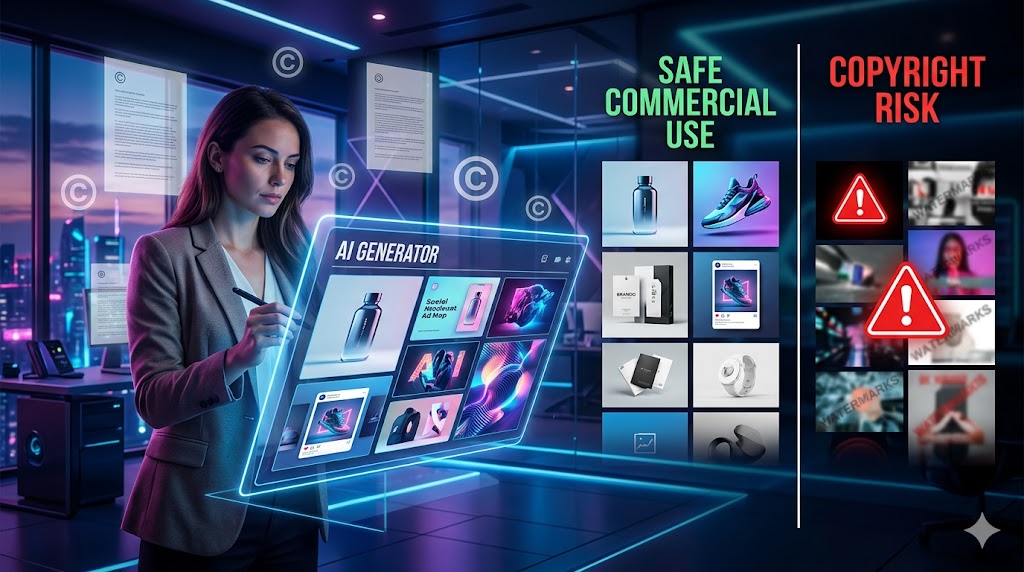
Because of this uncertainty, businesses should always check the terms of the AI tool before using images commercially.
Legal Risks of Using AI Images in Business
Even though AI tools are convenient, there are real legal risks you must understand:
1. Copyright Infringement Risk
AI models are trained on large datasets that may include copyrighted images. If a generated image resembles an existing copyrighted artwork too closely, it may create legal issues.
2. Trademark Violations
If your AI image includes logos, brand names, or recognizable characters, it can lead to trademark disputes.
3. Model Licensing Violations
Using images outside the allowed license (for example, reselling restricted content) can result in account bans or legal claims.
4. Ethical Content Issues
Some AI outputs may unintentionally create sensitive or inappropriate visuals, which can harm brand reputation.
Best Practices for Safe Commercial Use
To safely use AI-generated images in your business, follow these practical guidelines:
First, always read the license agreement of the AI tool you are using. Platforms like Midjourney, Adobe Firefly, and others have different commercial usage rules.
Second, avoid using prompts that request copyrighted characters, celebrities, or branded visuals. Even if AI generates them, legal risks remain.
Third, modify and enhance AI images using editing software. Adding human creativity increases originality and strengthens copyright claims in many jurisdictions.
Fourth, use AI images as part of a larger creative process rather than standalone stock assets. This reduces legal ambiguity.
Finally, if you are running a business, consider using AI tools that explicitly offer commercial-safe datasets and enterprise licensing.
AI Image Generators and Business Opportunities
Despite legal concerns, AI image generation opens massive opportunities for businesses.
Freelancers can sell AI-enhanced design services to clients at scale. Marketing agencies can produce campaign visuals faster and cheaper. E-commerce businesses can generate product mockups without expensive photoshoots.
Content creators can design thumbnails, blog visuals, and social media posts instantly. Even small businesses can build full branding systems using AI-generated graphics.
The key is not just using AI, but using it responsibly and legally.
Future of AI Image Copyright (2026 and Beyond)
Legal systems around the world are still evolving to handle AI-generated content. By 2026, many countries are expected to introduce clearer rules regarding:
- AI authorship rights
- Dataset transparency
- Commercial licensing standards
- Compensation for original artists
We are moving toward a hybrid system where AI-assisted content is treated differently from fully human-created content.
This means businesses should stay updated with regulations, especially if they rely heavily on AI visuals for revenue generation.
Conclusion
AI image generators are powerful tools that can revolutionize design, marketing, and content creation. However, using them for commercial purposes requires careful understanding of licensing, copyright laws, and platform rules.
The safest approach is simple: choose licensed tools, avoid risky content, and always add human creativity to your AI-generated visuals. This not only keeps your business legally safe but also improves originality and brand value.
As AI continues to evolve, those who understand both its creative power and legal boundaries will have the biggest advantage in the digital economy.